.webp)


Finally, the kind of tool hedge funds have used for decades — built for individual investors.
An algorithm that does the trading for you, right in your own brokerage account.
2,232%
52%
4.4%
87.2%
Combined 12-algorithm portfolio, January 2020 – July 2026. Futures trading involves substantial risk of loss. Past performance is not indicative of future results.
45 minutes - no cost
/ Strong performance
Performance Comparison: Vincere vs S&P 500
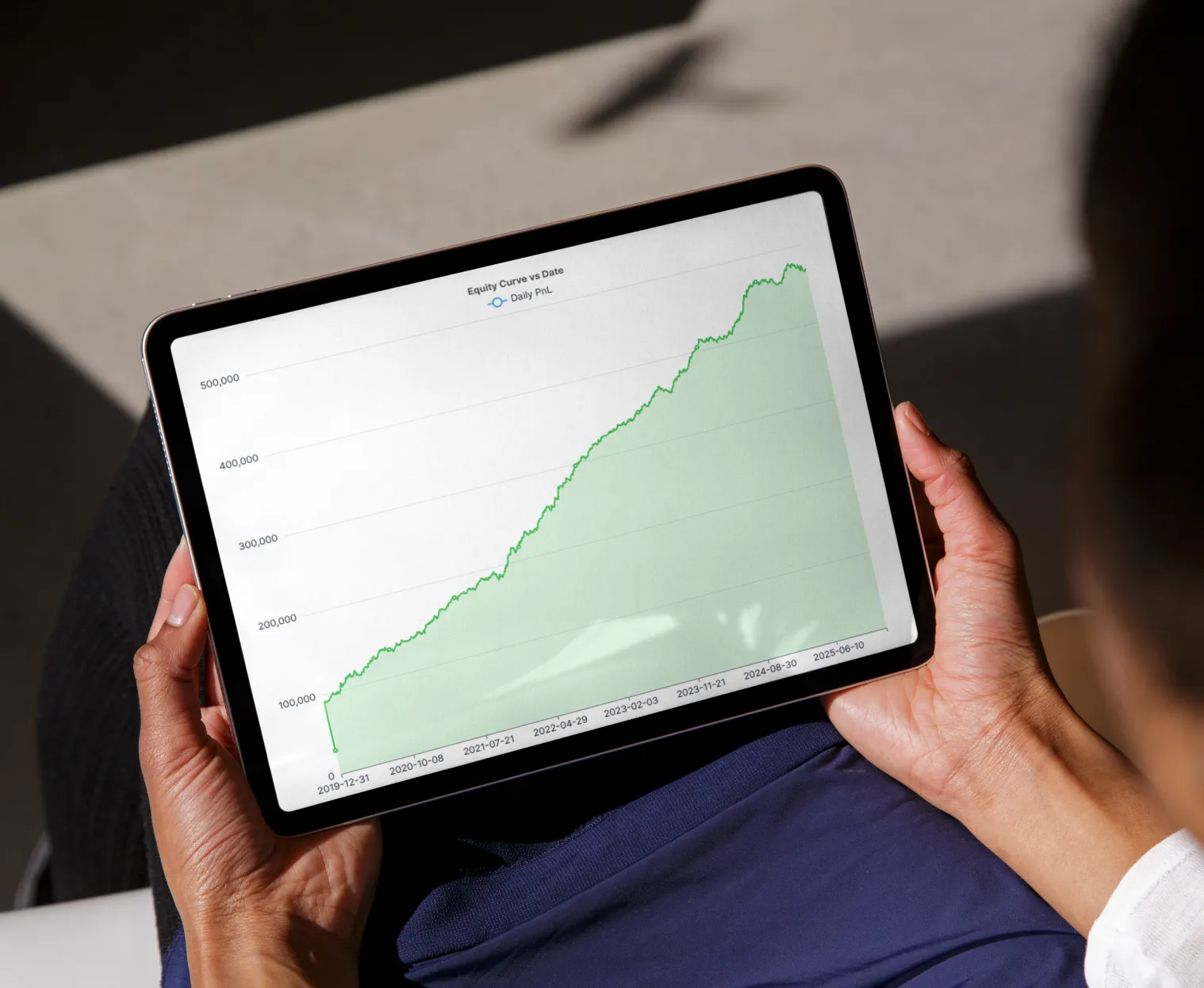
Since inception in 2020, the Vincere suite has outperformed the S&P 500 on return, volatility, and drawdown — while moving almost independently of it.
Combined 12-algorithm portfolio, January 2020 to July 2026. A correlation of −0.21 means the suite has moved largely independently of the stock market rather than alongside it. Past performance is not indicative of future results.
/ Since inception
Strong market outperformance since January 2020.
Based on a $120,000 initial balance — the level at which all twelve algorithms run.
Vincere Algorithm
S&P 500
Chart draws once sourced month-by-month returns and a benchmark series are supplied.
Hypothetical growth of a $120,000 balance applying the published monthly returns of the combined twelve-algorithm suite. Does not reflect VPS costs, taxes, or the timing of individual deposits. Past performance is not indicative of future results.
/ Full record
/ The access gap
Individual Investors Are Underexposed to Algorithms
- Institutional desks have run systematic strategies for decades. Individual investors largely haven't — not because the strategies stop working at smaller size, but because access required tens of millions in capital, a quantitative research team, and infrastructure that only an institution could justify building.
- That gap has been a matter of access, not merit. The strategies were never unavailable in principle; they were unavailable in practice to anyone without a trading floor behind them.
- That's where Vincere comes in. The same category of systematic strategy, running inside a brokerage account or IRA that stays in your own name — at a size an individual investor can actually fund.
/ How it Works
One algorithm is a strategy. Twelve is a portfolio.
The mechanics are less exotic than the category makes them sound. Three things are doing the work, and the third is the one that matters.
Each algorithm is a fixed set of conditions
It watches price behaviour on a single futures contract and enters when its conditions are met — the same logic in month 70 as in month one. Every trade carries a defined stop of 0.27% to 3%, and nothing is held overnight.
No discretion, no self-learning, no drift. That's deliberate: a system that changes its mind can't be measured against its own history.
Regulated futures, both directions
E-mini S&P 500 and Nasdaq 100 contracts, cleared through the CME and overseen by the CFTC. Deep liquidity, centralized pricing, nearly 24-hour sessions, and Section 1256 tax treatment.
Because a futures algorithm can go short as readily as long, it earns from movement rather than direction — which is why correlation to the S&P sits below zero.
Twelve of them, uncorrelated
Any single strategy has stretches where its conditions stop appearing. Run twelve that respond to different market behaviour and those stretches rarely overlap.
That's the whole argument. The individual algorithms aren't smoother than anyone else's — the combination is.
See it running before you decide.
Forty-five minutes with a Managing Director. Bring your questions about drawdowns, costs, and account structure — those are the useful ones.
45 minutes - no cost


.svg)
.svg)
.svg)